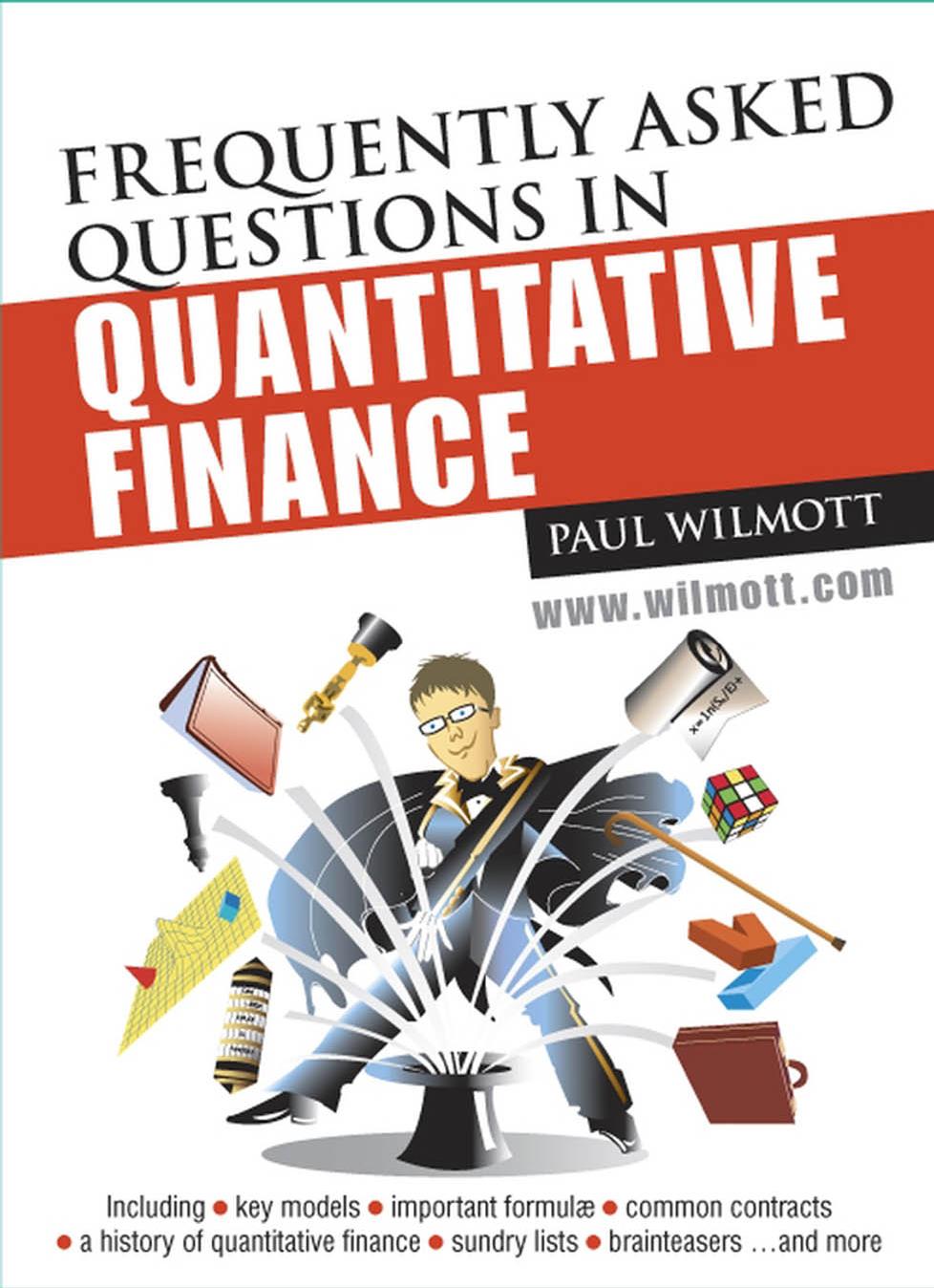
Frequently Asked Questions in Quantitative Finance by Paul Wilmott
Author:Paul Wilmott
Language: eng
Format: mobi, pdf
Publisher: Wiley
Published: 2010-05-18T21:00:00+00:00
Example
Historically a stock has grown by an average of 20% per annum when the risk-free rate of interest was 5%. The volatility over this period was 30%. Therefore, for each unit of risk this stock returns on average an extra 0.5 return above the risk-free rate. This is the market price of risk.
Long Answer
In classical economic theory no rational person would invest in a risky asset unless they expect to beat the return from holding a risk-free asset. Typically risk is measured by standard deviation of returns, or volatility. The market price of risk for a stock is measured by the ratio of expected return in excess of the risk-free interest rate divided by standard deviation of returns. Interestingly, this quantity is not affected by leverage. If you borrow at the risk-free rate to invest in a risky asset both the expected return and the risk increase, such that the market price of risk is unchanged. This ratio, when suitably annualized, is also the Sharpe ratio.
Download
Frequently Asked Questions in Quantitative Finance by Paul Wilmott.pdf
This site does not store any files on its server. We only index and link to content provided by other sites. Please contact the content providers to delete copyright contents if any and email us, we'll remove relevant links or contents immediately.
Whiskies (Collins Gem) by dominic roskrow(45519)
Spell It Out by David Crystal(36221)
Cecilia; Or, Memoirs of an Heiress — Volume 1 by Fanny Burney(32712)
Cecilia; Or, Memoirs of an Heiress — Volume 2 by Fanny Burney(32075)
Cecilia; Or, Memoirs of an Heiress — Volume 3 by Fanny Burney(32058)
Beautiful Disaster by McGuire Jamie(25445)
Trainspotting by Irvine Welsh(21957)
Chic & Unique Celebration Cakes by Zoe Clark(20141)
The Secret History by Donna Tartt(19443)
How High Can a Kangaroo Hop? by Jackie French(18842)
Twilight of the Idols With the Antichrist and Ecce Homo by Friedrich Nietzsche(18761)
All the Missing Girls by Megan Miranda(16648)
Cat's cradle by Kurt Vonnegut(15539)
Ready Player One by Cline Ernest(15122)
For the Love of Europe by Rick Steves(14863)
Fifty Shades Freed by E L James(13340)
4 3 2 1: A Novel by Paul Auster(12602)
Crooked Kingdom: Book 2 (Six of Crows) by Bardugo Leigh(12440)
Grundlagen Kreatives Schreiben (German Edition) by Helfferich Pia(10519)
